Recently as I have started to dive into learning about 2D and 3D animation JS libraries, I realized that GSAP would be the perfect tool to help me implement animations for a 2048 game. A couple years back I built 2048 with Elm, a fully functional programming language, for a graduate level functional programming course (play it here). The game was a success but it lacked animations, thus I was inspired to build it again with TypeScript!
So check out my new implementation of 2048, built with TypeScript, Svelte, Tailwind, GSAP, and more! Click below:
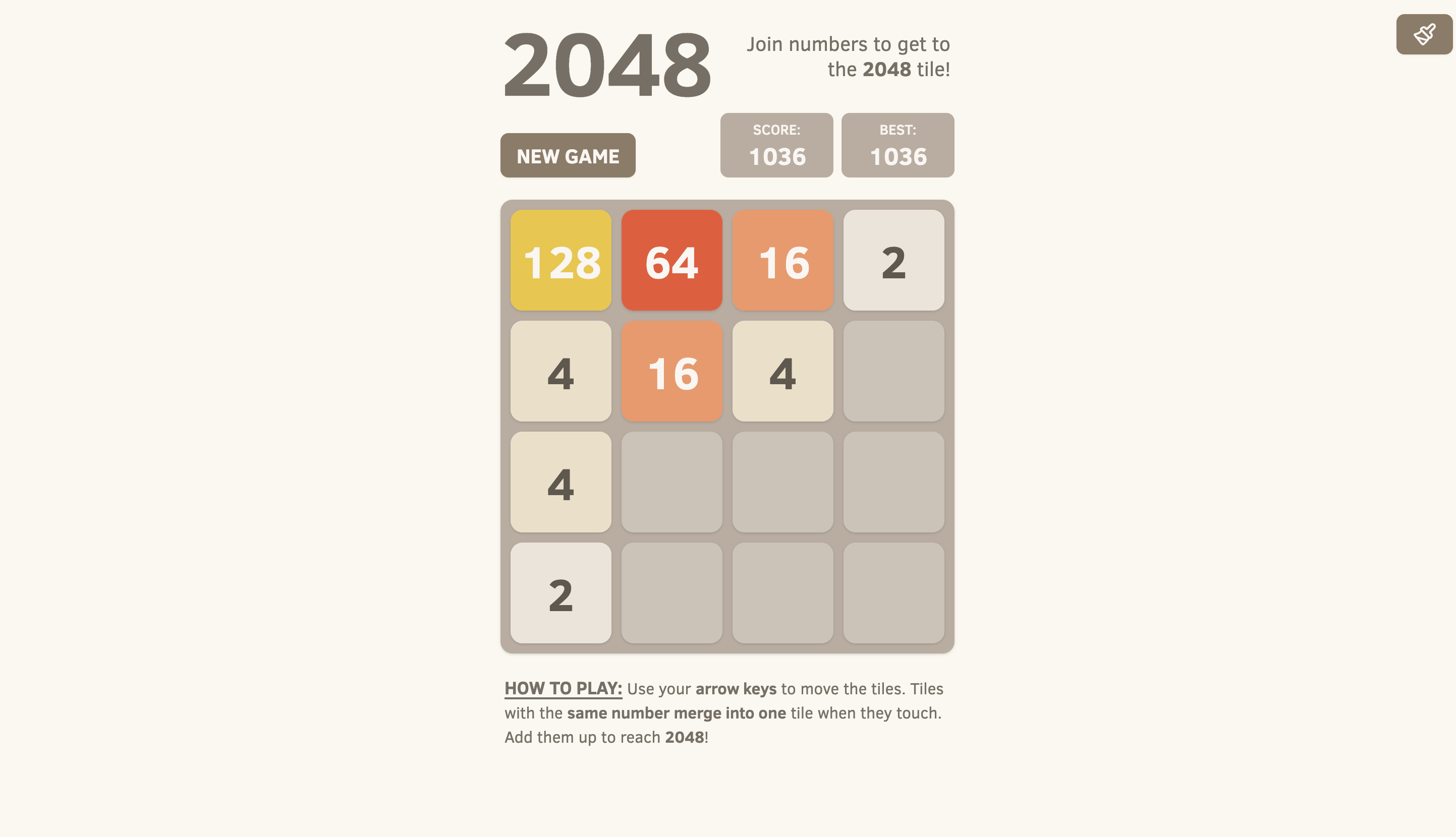
I implemented the game with minimal AI-assistance, writing the game logic and animation logic myself. It turned out well! I still have some things I can polish up (including the merging logic potentially) at the time of writing this, but I was able to use my favorite web dev stack to build one of my favorite classic iPhone games.
Check out the code here! A little bit about the implementation: So, the hardest part implementation was the sliding/merging logic. When first building the game I started to implement sliding (along with animations) one tile and one space at a time. After then adding tile spawning and merging logic, things became a mess and everything was also broke. At this point the animation was also breaking and tiles were sliding out of the board. I added a move lock where a move couldn't occur until a after a certain amount of time since the last run, enough to allow time for all the animations to finish and prevent the spamming of keys to break the game.
For merging and sliding, the key was to come up with the right algorithm; this involved first sliding tiles, performing merge logic on the matching/touching tiles according to the game rules, and then doing another slide to pack tiles after merging. After doing these slide/merge steps, I create a Record that map tile IDs to the tiles' new positions on the board; I use this map to loop over my board tiles and animate them sliding into place and merging (and also perform style changes).
The tiles that you see in the game are HTML Div elements that are styled with Tailwind (depending on the game state). I then perform position animations on the Div elements according to the width of the tiles in pixels (plus extra pixels for board-slot gaps) multiplied by the number of board slots that tiles move, in addition to scale and opacity animations for tile merging and spawning. I use 16 Div elements (as the board has a max of 16 slots) that are used and freed up while merging and spawning in tiles.
Essentially the game listens for a arrow key press event, then it performs the sliding/merge logic, and then performs the animations given the new game state on every move. I also added themes and an animated popover menu for switching themes!
Overall, I had a blast building this! I was definitely an improvement over my last 2048 implementation. 2048 is actually well-suited for Elm's state-driven UI rendering, but I think building the game with TypeScript was easier - and GSAP was perfect for adding animations. If you are reading this thank you for reading and playing!
- MARCUS,